

For Alberta families, Grades 3 to 6
Practice that keeps pace with the classroom
Larchmark plans short after-school practice around what your child's class is learning this week, on paper or on screen, and shows you what's sticking.
The sample needs no account, and nothing in it is saved.
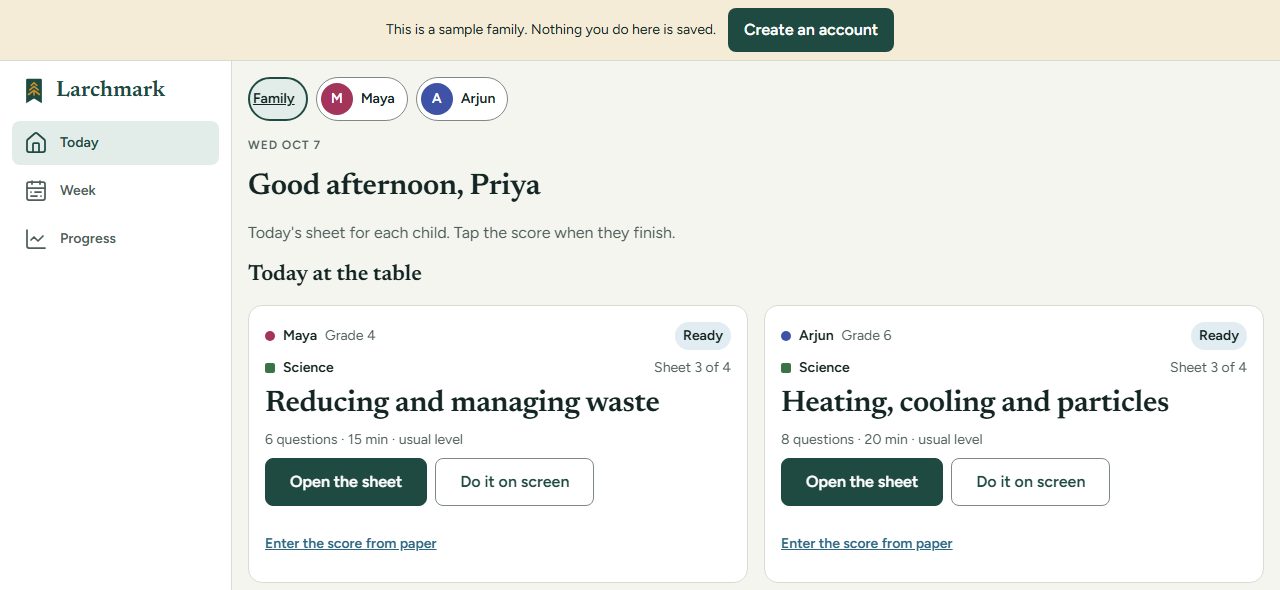
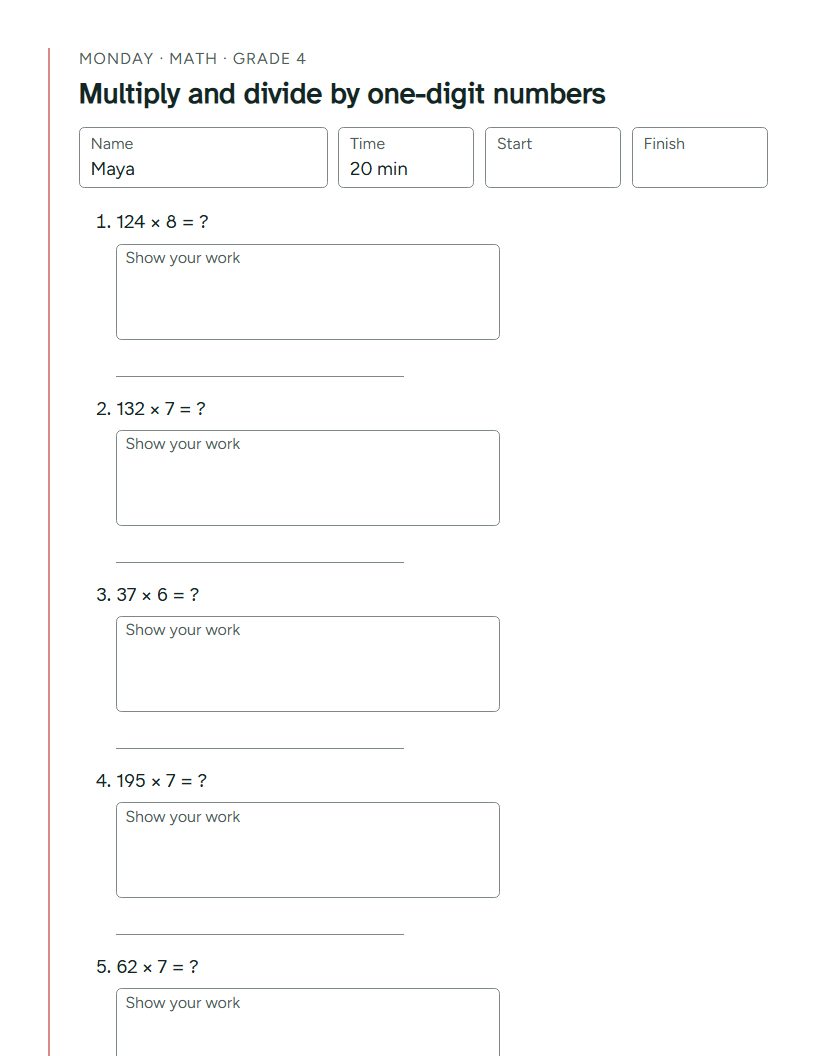
After school shouldn't be guesswork
What's on at school this week?
The bag comes home, and the week stays a mystery.
Printouts that don't match class
Generic worksheets drill last term, or next year.
Apps that add screen time
Another game is the last thing after a school day.
One week, start to finish
The same calm loop every week, with the minutes each step takes.
- SundayConfirm the week's topics1 minute, you
- SundayPrint the pack1 minute, you
- Monday to ThursdayA short sheet each day15 to 30 minutes, your child
- Each dayTap the score10 seconds, you
- FridayThe Weekly check15 minutes, your child
- FridayRead the Friday note1 minute, you
A printed week, ready on Sunday
One pack per child: four daily sheets, the Weekly check, a fridge tracker and the answer key at the back. Prefer screens? Every sheet works on screen too.
A short sheet each weekday 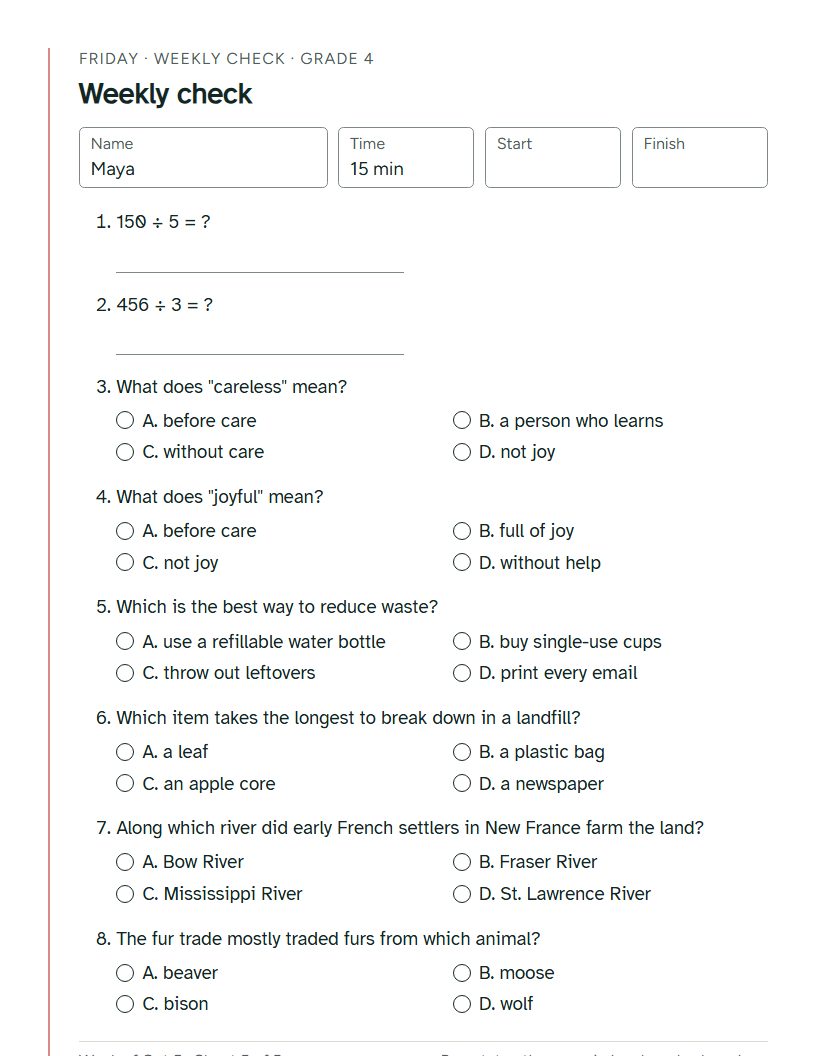
The Weekly check on Friday 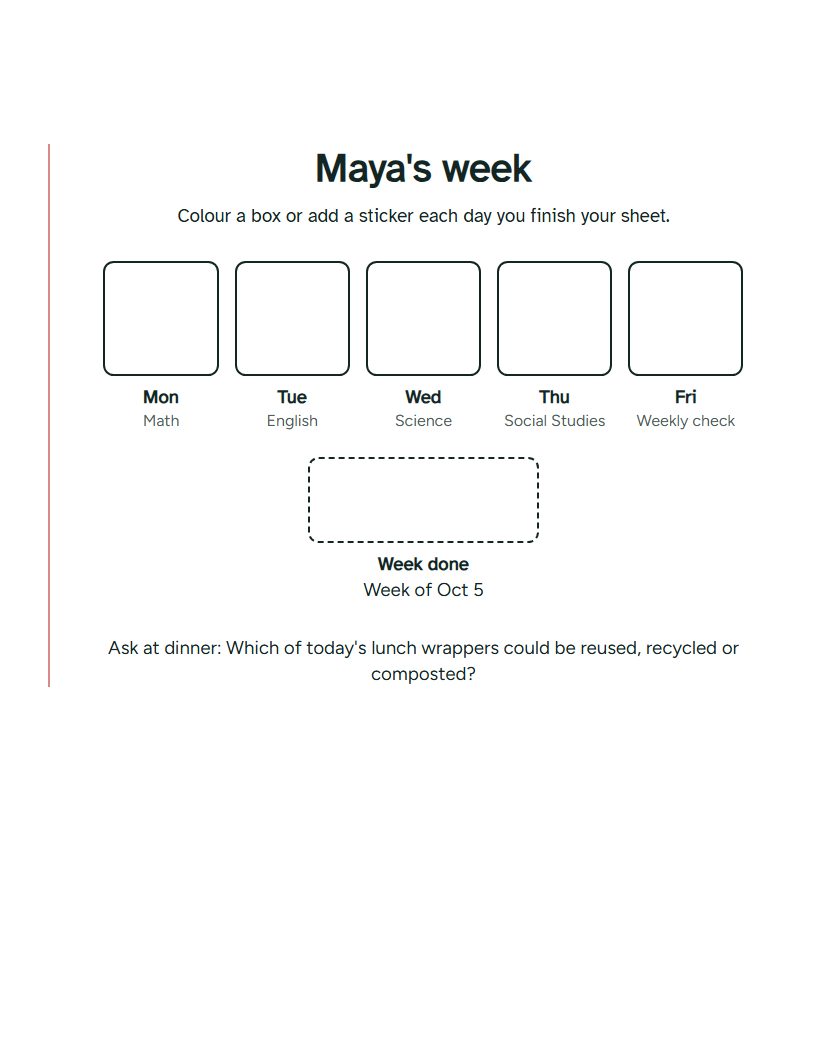
A fridge tracker for stickers 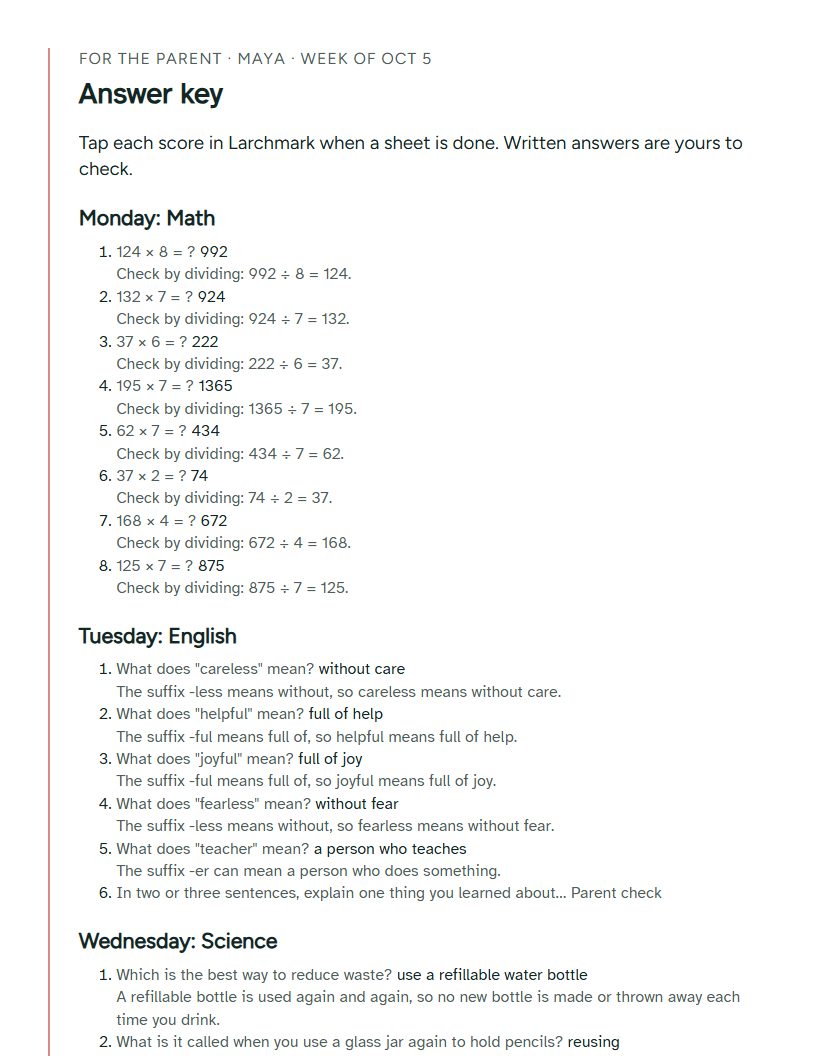
An answer key, on its own page
A few minutes of your week
Plan and print on Sunday, tap a score each day, read the note on Friday.
- Topics are suggested for you. Confirming the week is one tap.
- Mark the sheet with your child, then tap the score. That's the whole record.
- The Friday note says what's sticking and what needs another look.
Built on what Alberta teaches
106 topics across four subjects, following Alberta's new K–6 curriculum in the order classes usually teach it. Open a subject to see its topics.
Grade 3
Math10 topics
- Place value to 10 000
- Add and subtract within 1000
- Multiplication and division facts to 10 × 10
- Fractions as equal parts of a whole
- Equations with an unknown
- Length in centimetres and metres
- Polygons: sides and vertices
- Tell time on analog and digital clocks
- Patterns in number sequences
- Collect and read data
English8 topics
- Use strategies when a text gets hard
- Read words with vowel teams
- Prefixes change word meaning
- Capitals, end punctuation and plurals
- Draft, revise and share writing
- Fact, opinion and kinds of text
- Read aloud accurately and with expression
- Give a short oral report
Science5 topics
- Changes in substances and the water cycle
- Forces and simple machines
- How Earth's surface changes; fossils
- How living things interact
- Algorithms and computational thinking
Social Studies4 topics
- Alberta's land, regions and rivers
- First Nations, Métis and francophone contributions in Alberta
- Provincial and municipal government
- Fairness and standing up to discrimination
Grade 4
Math10 topics
- Place value of whole numbers
- Multiply and divide by one-digit numbers
- Equivalent and comparing fractions
- Decimals to hundredths
- Solve equations with an unknown
- Area and perimeter of rectangles
- Angles
- Elapsed time
- Patterns and rules
- Collect data and interpret graphs
English7 topics
- Main idea and supporting details
- Suffixes and word meaning
- Apostrophes and commas
- Organize paragraphs around a clear idea
- Fact, opinion and author's purpose
- Read with phrasing and expression
- Present ideas clearly to an audience
Science5 topics
- Reducing and managing waste
- Gravity and magnetism
- Structures and senses of living things
- Objects in space
- Design processes
Social Studies4 topics
- Early settlement and the fur trade
- The Treaty of Paris and the Rebellions of 1837
- Confederation
- Rights and responsibilities of citizens
Grade 5
Math10 topics
- Whole numbers into the millions
- Multiply multi-digit numbers; divide with remainders
- Equivalent fractions and comparing fractions
- Decimals to thousandths
- Factors and multiples
- Equations with a variable
- Area and perimeter
- Angles and triangles
- Mode, median and range
- Patterns and rules
English7 topics
- Make inferences from a text
- Synonyms and context clues
- Homophones and quotation marks
- Write to persuade with reasons
- Figurative language
- Adjust reading rate for the text
- Discuss and respond to others' ideas
Science5 topics
- The particle model of matter
- Forces in water and air
- Body systems
- Observing the sky
- Fair tests and controlled experiments
Social Studies4 topics
- Early civilizations and their environments
- Trade networks of the ancient world
- How ancient empires were ruled
- Legacies of ancient civilizations
Grade 6
Math10 topics
- Integers
- Factors, primes and multiples
- Ratios and percents
- Order of operations
- Operations with fractions and decimals
- Expressions and equations
- The coordinate plane
- Area of triangles and parallelograms
- Mean, median and range
- Probability of simple events
English7 topics
- Support answers with evidence from the text
- Greek and Latin roots
- Subject–verb agreement and complete sentences
- Revise for flow, order and support
- Genres and figurative language
- Read a range of texts with expression
- Adjust speaking for purpose and audience
Science5 topics
- Heating, cooling and particles
- Managing energy resources
- Ecosystems and biodiversity
- Technologies for exploring space
- Coding structures
Social Studies5 topics
- Direct democracy in ancient Athens
- Representative government in ancient Rome
- The Haudenosaunee Confederacy
- Canada's levels of government
- The Charter of Rights and Freedoms
Grades 7 and 8
Planned for 2027.
Larchmark is independent. It isn't made or endorsed by Alberta Education or any school board.
From paper to progress
Each score updates the topic it practised, so you see what's strong and what's shaky, in words as well as colour.
Grows with your child
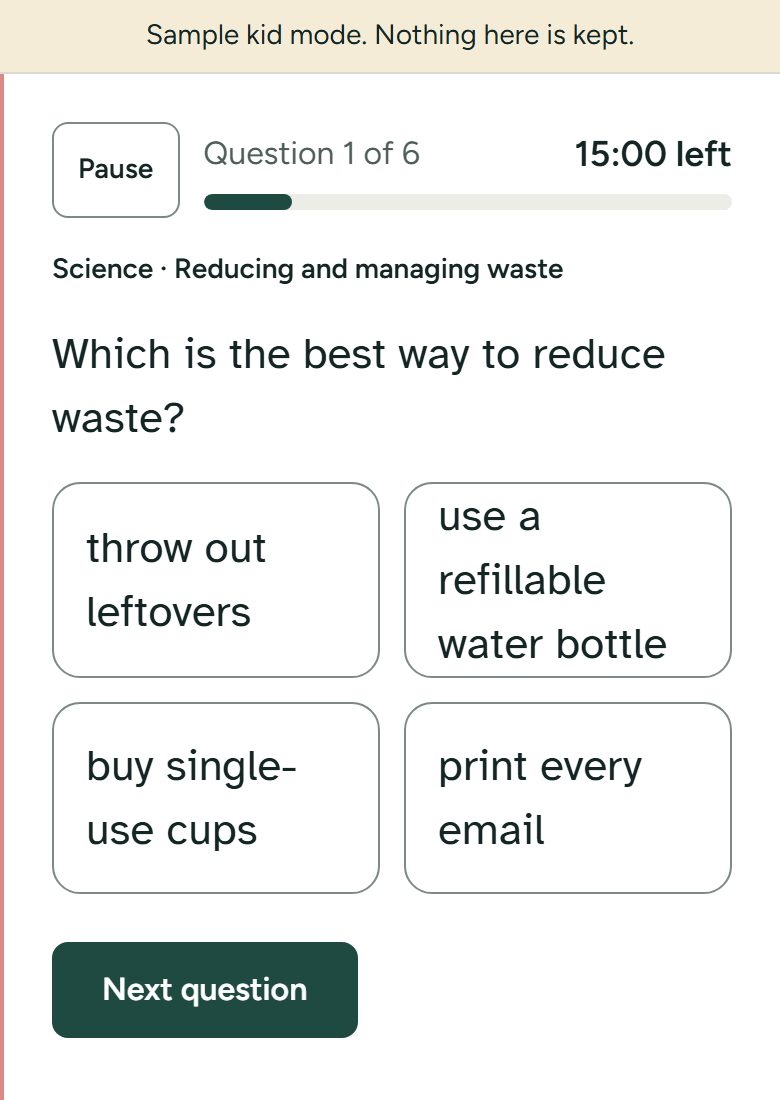
- Grades 3 to 6: kid mode. Hand over your phone or tablet and your child does the sheet on screen. The score saves itself.
- Or on paper. Every sheet prints, with lines spaced for the grade and an answer key for you.
- Grade 6: their own login, coming later. Older children will see their own week and results on their own device, with your consent.
Your family's data stays in Canada
Stored in Canada
Your family's data is kept in a Canadian data centre.
Your account
Children are added by a parent; they never sign up alone.
Only what we need
A first name, grade and colour for each child. Nothing more.
No ads or trackers
No advertising and no third-party analytics, ever.
Two plans
Price announced before launch.
Free
For one child, Math every weekday.
- One child
- Math on every weekday sheet
- The print pack, kid mode and the Weekly check
- The Friday note and progress by topic
Family
For the whole family, every subject.
- Up to four children
- Math, English, Science and Social Studies
- Everything in Free
Questions
Which grades does Larchmark cover?
Grades 3 to 6, on Alberta's new K–6 curriculum. Grades 7 and 8 are planned for 2027.
How does it know what the class is learning?
It follows the order Alberta classes usually teach the curriculum. On Sunday you see the suggested topic for each subject and confirm it, or pick another, if your child's class is somewhere else.
Do we need a printer?
No. Every sheet can be done on screen in kid mode. Printing is there for children who do better on paper.
How long does it take?
A sheet takes 15 to 30 minutes, depending on the grade, or the length you choose. Your part is about a minute on Sunday and a tap each day.
What do you keep about my child?
A first name, grade and colour, and the scores you record. Data is stored in Canada, with no ads or trackers.
Is Larchmark connected to my child's school?
No. Larchmark is independent and isn't made or endorsed by Alberta Education or any school board.
When can we start?
Larchmark opens to Alberta families in 2027. You can look around a sample week now, with no account.
See a week before you sign up
Look around a sample family. No account needed, and nothing is saved.
Opening to Alberta families in 2027.